
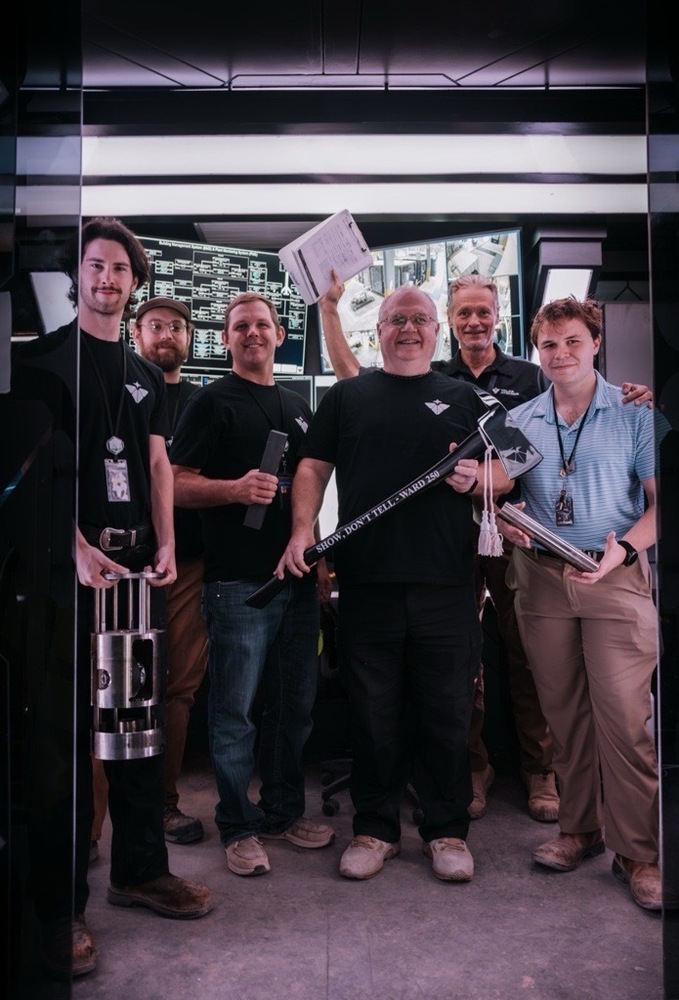
“Nothing moves, nothing turns on, nothing lights up without our team touching it.”
That is how Northeast Tech alumnus Joe Lillard describes the responsibility his engineering team carries today.
A Miami, Oklahoma, native and graduate of the STEM program at Northeast Tech’s Afton Campus, Lillard is now the lead instrumentation, control and electrical engineer at Valar Atomics in Torrance, California. His team is responsible for the electrical power, controls and sensors for the company’s reactor, touching everything from neutron detectors and control room design to the code that controls the reactor.
It is complex work with high stakes, but Lillard’s path toward engineering started long before his career did. In fact, ask him how old he was when he first knew he wanted to become an engineer, and his answer is simple: probably four.
By the time he reached high school, Lillard wasn’t looking for someone to help him figure out what he wanted to do. He was looking for a place that would challenge him to do more.That’s when he found Northeast Tech.
“It was real world,” Lillard said when asked why he chose the STEM program. “It was a chance to actually get hands-on and build some stuff, and it was the most accelerated academic program around.”
For Lillard, the opportunity meant doing real work, learning at a faster pace and being pushed beyond what he had experienced before. Rather than changing the future he pictured for himself, his time at Northeast Tech reinforced that engineering was where he belonged.
He remembers the hands-on experiences in Trisha Masterson’s class and, in particular, the program’s capstone project. Students were tasked with taking an idea through the entire engineering process, from inception to delivering something real that worked.
“That was one of the biggest, best things,” Lillard said.
But when Lillard looks back at what he gained from Northeast Tech, one skill stands out above the rest: problem-solving.
Growing up in rural Oklahoma had already given him plenty of opportunities to figure things out. At Northeast Tech, he said, problem-solving became less about chance and more about learning a method for approaching a challenge.
“The program very much accelerated that and taught it not as some sort of perchance thing, but as a method,” Lillard said. “I’ve carried that through to today, and it still helps me on a daily basis to be able to break down problems and really figure stuff out.”
The problems he works on today may look very different from the ones he tackled as a high school student, but the approach has stayed with him.
Lillard said the engineering method he began practicing at Northeast Tech still helps him work through difficult problems in a deliberate, methodical way.
That early experience also gave him a head start on what came next.
Lillard credits Northeast Tech with helping him build a portfolio, preparing him to enter college at a high level and introducing him to engineering fundamentals that he believes gave him an advantage over others.
He also credits instructor Jeremey Radebaugh with preparing him for the expectations he would face after high school.
“Mr. Radebaugh treated us as adults, with real stakes and real deadlines,” Lillard said. “This was the most important preparation I received for college.”
Yet, when he talks about his two years at Northeast Tech, his memories are not limited to academics.
He remembers having fun. He remembers the people. And he remembers what it felt like to be surrounded by students who were interested in the same things he was.
“It was a lot of like-minded people, and it’s difficult to get that in rural Oklahoma,” Lillard said. “And then the other thing is, again, just the introduction and the opportunity to get hands-on with real engineering problems at such a young age was very, very important to me.”
Years later, Lillard is no longer a student wondering how to solve a classroom engineering problem. He is leading a team of engineers tackling some of the most complicated problems of his career. But his story is also proof that where someone begins does not have to determine how far they can go.
“The world is actually really small, and it doesn’t really matter where you come from,” Lillard said. “If you truly want to do something, nothing’s going to stop you from doing it.”
It is a message he hopes current students will hear, particularly those trying to decide whether Northeast Tech is the right next step for them.
Instead of simply telling a high school sophomore to enroll, Lillard would first ask them a question.
“What are you looking for?” he said. “Are you looking for a challenge? Are you looking to move to the next level?”
For students who are willing to be challenged, who want to tackle difficult things and who are ready to see just how far they can push themselves, Lillard knows where he would send them.
“If you want to do hard things and you want to get really good at them,” he said, “this is the place to be.”